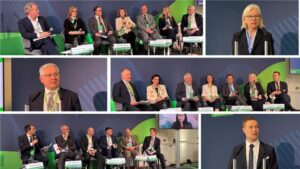
Nordic Financial Ecosystem Forum 2026
On 22 April, the Swedish Securities Markets Association in the context of the Nordic Securities Association (NSA) co-hosted the 8th edition of the Nordic Financial Ecosystem Forum in Brussels together with Nasdaq. The theme of this year’s forum was Agile and Digital Capital Markets for a Competitive EU.
Marko Niemi Chair, Nordic Securities Association, held an introductory remark and emphasized that EU financial markets are falling behind and decisive action is needed. Excessive focus on technical details and Level 2 measures has resulted in an overabundance of rules. Part of the solution would be more solid impact assessments, more effective consultation processes, earlier consideration of Level 2 measures, and a more stable regulatory framework.
This was followed by a keynote speech by Alexandra Jour-Schroeder, Deputy Director-General and Acting Director, General Affairs DG FISMA, European Commission. She highlighted that the current Commission’s mandate is to meet geopolitical challenges, stressed the critical importance of the Savings and Investment Union (SIU), noted that the MISP proposal is a forward-looking and ambitious package designed to foster a more integrated environment for sales, trading, and post-trade, supported by more efficient supervision, and underlined the importance of digitalisation in creating more agile markets and value creation.
Building competitive and efficient EU Capital markets
The keynote speech was followed by a panel on Building competitive and efficient EU Capital markets – Global dimension of Financial Markets, with moderator William Wright Founder & Managing director, New Financial, and panellists Tanya Panova Head of CMU Unit, European Commission, Adam Kostyál Senior Vice President and Head of Listings EMEA, Nasdaq Nordic, Aleksandra Maczynska Chief Executive Officer, Better Finance, Andy Mitchell President & CEO, Securities and Investment Management Association of Canada, Phil Mackintosh Chief Economist, Nasdaq, and Emma Hedman Chief Operating Officer, Young Personal Finance (Ung Privatekonomi).
The panel noted that key factors behind the successful Swedish capital market include strong commitment from government, regulators, and investors; a focus on investor education in schools through private initiatives such as Young Personal Finance; a large pool of active institutional capital including public and labour market agreed pension funds as well as retail investments; trust in regulators and supervisors; incentives supporting innovation and investments, including tax measures; and a social safety net that allows for risk-taking.
As a comparison to the EU, Canadian retail investment is even larger than pension investments. At the same time, Canada faces some challenges like the EU, with a regulatory structure that is fragmented, with each province having its own securities regulator. The US on the other hand has certain structural advantages: around 55% of Americans have 401(k) retirement accounts; there is no financial transaction tax; tax incentives support investing; a single settlement system via DTCC operates across exchanges; and settlement is in a single currency.
However, it was noted that certain challenges remain also in the US, including high listing costs, fragmentation of trading venues, reliance on a pre-trade consolidated tape, and issues related to odd-lot trading.
Creating an effective supervisory model for EU financial markets
Our CEO Urban Funered thereafter moderated a panel on Creating an effective supervisory model for EU financial markets, with panellists Markus Ferber Member of European Parliament, Daniel Andersson Vice-Chair of the Swedish Securities Markets Association and Head of Handelsbanken Capital Markets, Armi Taipale Head of Capital Markets Supervision, Finnish Financial Supervisory Authority, Sandrine Ménard Deputy Director – Financing of Companies/Financial Markets, French Treasury, Adam Kostyál President of Nasdaq Stockholm, and Iliana Lani Head of Conduct Supervision and Convergence Department, ESMA.
The panel discussed the supervisory component of MISP, noting that compared to the situation when the previous ESA review took place, in 2018/19, not least the geopolitical context is different. Supervision and regulation are being considered together, and there is real momentum around innovation. While panellists had slightly different views on the time plan, intensive work is underway. Execution risk is however significant, and the panel agreed that any transfer of powers must not result in excessive bureaucracy, unclear rules or divisions of powers, or excessive cost increases. There was agreement that ESMA as an institution will have to develop, and the experiences and knowledge of National Competent Authorities as well as market participants must be utilised.
It was argued that an expanded ESMA mandate would serve to address divergent interpretations of regulation. It was also proposed that ESMA needed to play a more active role in promoting greater interoperability, as regulatory arbitrage remains an issue across Europe.
Panellists noted that MISP will not on its own be sufficient to ensure well-functioning markets or drive European growth. Reforms are also needed at the Member State level, and action can already be taken without waiting for EU-level changes. As an example, Sweden has built a strong SME market and active retail participation within the current framework. Cost control will be important, as unnecessary costs or regulatory burdens on smaller but important market participants, such as SME-focused market providers, will have a negative impact on growth.
Digitalisation and tokenization of financial markets
The forum was concluded with a panel on Digitalisation and tokenization of financial markets, with moderator Vincenzo Renda Director for Digital Transformation, Digital Europe, and panellists Konstantinos Kaniouras Financial Services Directorate, Ministry of Finance, Cyprus, Mattias Levin Deputy Head of the Digital Finance Unit, DG FISMA, European Commission, Eun Ah Choi Senior VP, Global Head of Regulatory Operations, Nasdaq, Andreas Karlsson Strategic Advisor, DNB, Dirk Kruwinnus Chief Product Officer, Seturion GmbH, and Dr. Boris Kisselevsky Head of ECB Representative Office in Brussels, European Central Bank.
The panel raised the need for greater clarity in Europe on how to foster private capital investment in tokenisation. It was noted that in the U.S., market forces are ready to move forward, supported by clearer regulation.
The panel discussed the status of digitalisation, where Europe is in a different position than the U.S. The DLT Pilot Regime has proven to be a meaningful contribution, but there is a need for better harmonisation between regulation and market dynamics, ensuring that a strong European business ecosystem can benefit from the framework being created. At the same time, the regulatory burden must not stifle market development.
The US is ahead of the EU in certain respects, and needs to catch up, while avoiding fragmentation, regulatory arbitrage, and any erosion of investor protection. It was argued that the EU must act quickly to embrace tokenisation, and regulatory certainty is essential. It was noted that industry concerns are being considered in regulator discussions, with a level playing field for CSDs a priority. The DLT Pilot Regime here serves as a testing environment to explore developments. ECB is at the same time working on two parallel tracks: wholesale and retail (focusing on the digital euro).